
Summer and sunscreen go hand in hand...but how do you know if you’re using the right one?
Does it have UVA, does it have UVB, how much SPF and what about the PA level? Oh gosh...so many terms and sooo confusing!
Fret not dear readers! Because you’re on the right place and we have it all sorted for you!
Let’s get started...
The sun emits three types of ultraviolet radiations (UV rays) that reach our skin. These are Ultraviolet A (UVA), Ultraviolet B (UVB) and Ultraviolet C (UVC). UVC Rays which are the most harmful ones are blocked by the Ozone layer and thus does not enter Earth’s surface. Thank god for that!!! But both UVB & UVA rays could enter earth and harm the skin if left unprotected.
UVA result to be much more harmful to the skin than UVB rays because these rays reach the earth’s surface in a higher percentage and is present almost at all times. And that includes cloudy days too! So all you, who avoid a sunscreen on a cloudy day, you now know that it really was a bad idea.
So next time you buy a sunscreen, make sure it says ‘BROAD SPECTRUM UVA &UVB PROTECTION”
Now, another term worth knowing: SPF. SPF stands for Sun Protection Factor, and it is the key number you see on every SPF sunscreen label. Most people buy SPF 50 sunscreen with the highest number they can find, apply it once, and forget about it for the rest of the day. We are here to bust that myth for you. No matter how high the SPF is, your sunscreen needs to be reapplied regularly to actually do its job.
But again, re-apply when? Here’s how it works – SPF 10 means 1 hour protection and 20 means 2 hours and so on. So in case your SPF says 35, don’t be too happy about it in case you’re not re-applying it after 3.5 hours. Thank us later!
Now what is UVB rays? Well, UVB rays differ based on geographic locations, time of the day and even the season. Just like UVA rays, UVB rays are also present at all times of the day and night regardless of the season, the only difference is, it’s intensity fluctuates.
UVB is the real culprit behind your tan and skin irritations. UVB damage is visible and can be treated, but UVA rays are the real silent killers; they penetrate deep into the skin without you feeling or seeing a thing. This is why using a sunscreen for sensitive skin matters more than most people realize, as it protects against both UVA and UVB rays without causing redness or irritation.
Wanna stays protected from these harmful rays, but still confused with what sunscreen you should pick?? Just look for one that says ‘Broad Spectrum.’
SPF is the hero that protects you from UVB, and similarly a PA rating level helps you understand if your sunscreen is protecting you from the harmful UVA rays or not!
Another term? Trust us, we’re here! PA means that your sunscreen can provide you with UVA protection with PPD Factor (Persistent Pigment Darkening) ranging between two to four. This helps in providing protection of medium UVA radiation to high.
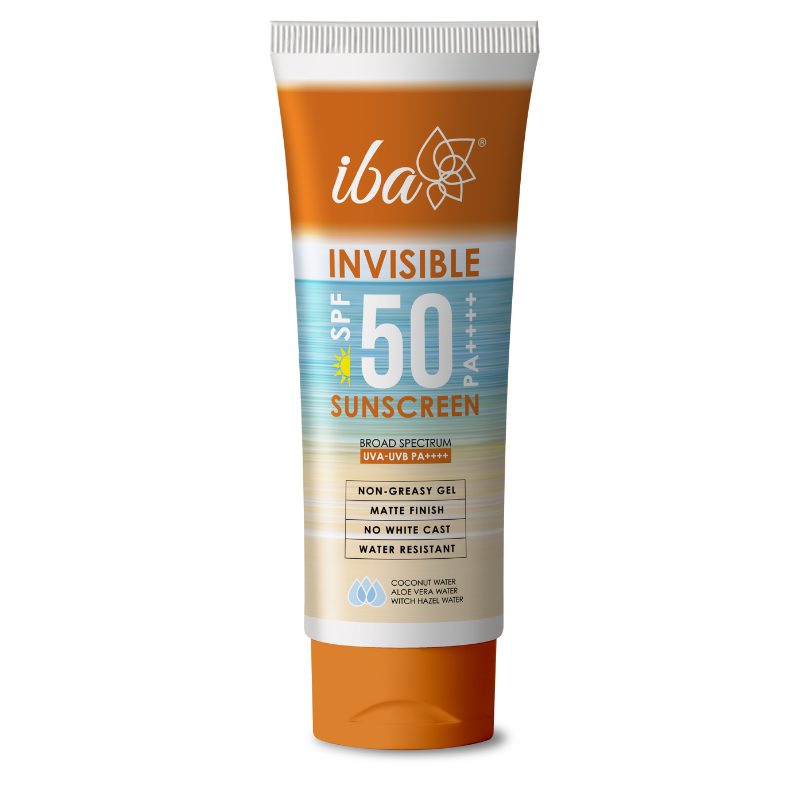
That’s most of it that you need to know about your sunscreen and if you’re still confused about which sunscreen you need to pick then just keep calm and pick Iba’s Invisible SPF 50 Sunscreen with a PA++++ rating. The best that you could ever have.
Infused with coconut water, aloe vera water and witch hazel water, this makes the perfect light weight sunscreen that isn’t greasy. It will protect your skin without leaving a white cast!
So hurry up and fill in your summer carts now!